
Why is Gregor Samsa So Big? A Paradox of Size
A Review of Franz Kafka’s The Metamorphosis: A Bug You Should Consider Catching
Ali Baloach | September 6, 2026
Seriously, why is Gregor Samsa so big? Franz Kafka’s, The Metamorphosis presents an absurd premise—a man turns into an enormous (contextually suggested, but not
explicitly affirmed) bug—and provides no reasonable explanation as to why he has to stand on his hind legs to twist a doorknob open with his insectoid jaws. A lot of questions have
arisen from the narrative of his transformation, but a strangely practical one, maybe even seemingly obvious to answer, stuck with me when two of my good friends and I uniformly squirmed at Gregor’s repugnant, oozing, clammy reality in our book club. Why is the bug so big?
If Kafka wanted Gregor’s insect body to communicate worthlessness or insignificance when he is forced out of the capitalist systems that ironically had him living a
sluggish and ant-like life, a tiny insect might seem more intuitive. A tiny Gregor could hide. He could disappear under furniture with much greater ease. He could potentially escape.
Instead, his rounded dome, unable to keep itself shielded with a quilt, makes ordinary human architecture his greatest initial obstacle. His physical bulk makes him a burden to
the same family whose burdens he had previously carried. This creates the first paradox of Gregor’s situation: he becomes socially insignificant at precisely the moment he becomes physically impossible to ignore.
If you look at people from far enough above, something happens to their individuality. Bodies become dots moving along prescribed paths. Ants going to gather resources for their anthill; spiders traversing zip lines of web above termites skittering through streets in droves. Individual lives become invisible from the same perspective that Gregor saw his own routines before his transformation. He’s frightened even of calling in sick because of judgement from his employer, instead recognizing freedoms he doesn’t possess in salesmen who eat breakfast with leisure. Most absurdly, he worries more about getting back to work than being unable to coordinate his obscured number of new limbs. Gregor dreams of escape in the confines of the pictures on his bedroom walls, but is caged by his family’s debts such that his transformation isn’t the beginning of his insect existence.
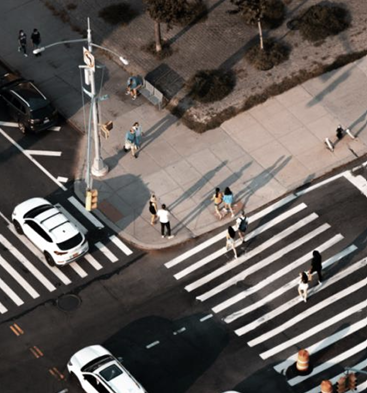
Figure 1. Pedestrians seen from above.
Photograph by Reinaldo Simoes, via Pexels.
Gregor’s human identity was overwhelmingly organized around what he produced, a measurement of success he internalized in a way I find most people do. A way that
emphasizes boisterous anxiety, engorging bitterness, overwhelming melancholy, infinite routine, and egregious shame. I hope those adjectives are cluing you into the point I’m
starting to skitter around. Gregor’s humanity has already been reduced before anything happens to his body. The metamorphosis is ultimately materializing a truth he was already
abiding by. Was he ever really talking to his family if his rampant thoughts of a life better than the one he was allowed remained deep-seated in his thorax? But if Gregor was already insignificant, and if his absence would create such a terrible financial burden for his family, why make the physical manifestation enormous?
We’ve rationalized by now that Gregor was always an insect of sorts. Perhaps applying this same derivation to his terror-inducing size can help answer our central
question. Economically, Gregor has always been enormous. He supported essentially the entire household. But the clear throughline with his metamorphosis into a bug before and
after the transformation disappears when considering his size. After transforming, Gregor produces… slime? Economically, he’s worthless, and yet his physical presence becomes
enormous and unignorable to his family. Does this reversal of burden invalidate every conclusion I’ve made up to this point? Gregor once carried his family, and now his family has to reconcile if they are supposed to carry Gregor.
This brings up a point I made before. Gregor’s disappearance would already create an unshakable burden for the family, so why did he have to be big? And if it’s the financial
conundrum creating that burden, why be so morally perplexed about taking care of him at all? Does his irritatingly obvious presence create hope that one day he might transform
back? Gregor’s worth continues to be measured according to his usefulness, now hidden in the subtext of how his family navigates their expounded financial ache and treats Gregor as he gets temporally more distant from his humanity. Gregor’s body makes an invisible burden, the one Gregor refuses to face and dreams about unshackling himself from, physically unavoidable.
Gregor’s bedroom is proper, but too small. Don’t you think that summarizes his human existence remarkably well? He possesses all the outward signs of a “proper” life, but it doesn’t fit him. After he transforms, this metaphor becomes the architecture he wrestles inside. His new body literally doesn’t fit comfortably into his old environment. Here, we can derive a second paradox: the larger Gregor becomes physically, the smaller his permitted world becomes.
Kafka wants us to apply a critical lens to the bug-like qualities of our own lives. What larger systems are we a part of that drive us to march in droves and carry burdens we would never choose to of our own accord? Is the consequence of ignoring the incessant buzzing telling you that you want something greater for yourself to end up like Gregor? Too big for your reality? If you’re following my train of thought, parts of your life are starting to feel like a big bug digging its tarsi into your back.
In the latter half of The Metamorphosis, I was astounded at my failure to recognize that few characters other than Gregor have names up to that point. Gregor retains a name while others are frequently relational: sister, mother, father. Then suddenly, Grete. What a unique name. Wait, a name? It seemed that as Gregor’s human motivations and independence became increasingly masked behind the brown slime pooling around him, his sister’s took the forefront. Likewise, mother and father become Mr. and Mrs. Samsa as Gregor declines and the family reorganizes itself. The people around a desolate Gregor, afflicted with the strange tragedy of losing everything that makes his name socially meaningful, develop identities and futures without him. By the end, Grete’s proposed future perpetuates the family’s cycle of burden by locating productivity in another person. Gregor’s large form is somehow small relationally, communicatively, linguistically, and too many other -lys to list. Is this the consequence of letting that big bug on your back dig deeper and deeper into who you are?
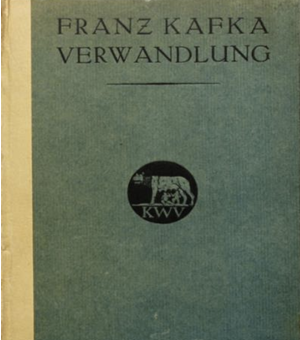
Figure 2. Original cover of Franz Kafka’s Die Verwandlung (1915/16).
Photograph by H.-P. Haack, via Wikimedia Commons, CC BY 3.0.
Why is Gregor Samsa so big? Gregor transforms from a small insect of a human into a human trapped inside a huge bug. Simultaneously, something invisible in Gregor’s life transforms into something impossible to ignore. His enormous body exposes dependency, confinement, uselessness, obligation, conditional acceptance, and shame from failing to confront the conditions that denied him the escapist skill set of a smaller bug. Gregor’s world shrinks around him. His productive value disappears. His relationships disappear. His ability to communicate disappears. And in the eyes of his family, Gregor Samsa disappears. After an entire review obsessing over Gregor’s physical form, I should probably bring up that Kafka famously objected to depicting what Gregor looked like. Maybe that was another way of cluing us into looking inward instead. I’m not saying that reading my review should give you an idea of how to solve capitalism, but I hope that I’ve encouraged you to read these (roughly) 60 pages by Kafka that start by looking down upon humans until they resemble insects and end looking for an enormous insect who has completely vanished. I hope that they clue you into taking care of yourself before you realize that the bug on your back is you.
About The Author
Ali Baloach is a third year health sciences student and Treasurer for The Last Page.