
On Flies and the French: L’événement by Annie Ernaux
Saachi Deshpande
Lately I have been thinking about how my favourite feeling as a reader is the spider-sense tingle of a literary web being weaved just beyond the peripheries of a text. As I painstakingly progress towards a goal of being “well-read” (whatever that means), I have slowly started to sense interauthorial influence. I’m a fly eavesdropping on the wall, catching only every third
word of a conversation between giants. Just enough to recognize something bigger than myself, often not enough to explain it clearly. Alas, I’m just a fly. Or something.

Ernaux in 2023
First published in 2000, L’événement (Happening, in English), is a novella-length memoir by Nobel laureate Annie Ernaux. I picked it up for an August book club on the theme of “Women In Translation Month.” Ernaux’s autobiographical account of her illicit 1963 abortion intrigued me. From my earliest days as a baby Irish feminist, the pro-choice movement has been a source of inspiration. As such, I was eager to expand my understanding of exactly the kinds of desperate and mortally dangerous predicaments that movement still fights to avoid. I was also eager for an opportunity to consume a translated work in its most complete form; though I have not read French fiction since completing my bilingual high school studies, I thought I would attempt to read the original French text in parallel with the 2001 English translation by Tanya Leslie.
This DIY bilingual reading experience (a few pages of the French, followed by the English, then back again) was delightful. I was able to witness some of the major structural changes wrought by translation. For example, Ernaux writes almost exclusively (and atypically) in the imperfect past tense. This creates a sense of stagnation, senescence, and dilating time that
is embedded into the prose as much as it is present in the narrative, as a young Ernaux sought means to terminate her pregnancy before it became too late. As English doesn’t quite have this linguistic machinery, the richness of Ernaux’s design falls into a slightly flatter (though still fitting) sense of detachment and alienation.
Some of my favourite wordplay didn’t survive the translation either. Ernaux describes her discomfort with the vocabulary of pregnancy: she couldn’t bear to think that she was “expecting” (en attente) or “pregnant” (enceinte), instead opting for oblique references to “that thing” (cette chose-là) in her diary. She was least comfortable with the French word for “pregnancy,” which is grossesse (literally translated, “enlargement”). She highlights its similarity to the word grotesque. It rather saddened me to think that I would have missed such a brilliant comment reading exclusively the English. Nor would I have learned that the French for “backstreet abortionist” is faiseuse d’anges: “angel-maker.” Such poetry to name a vocation that too often sparks revulsion and hatred, despite its ancient and essential nature. Translation, of course, can add just as it necessarily takes away. Once, I was struck by the beautiful rhythm in the English word “sunshine,” which is not quite the same as soleil. Fittingly, it seemed to light up the whole surrounding passage.
Ernaux in 1963
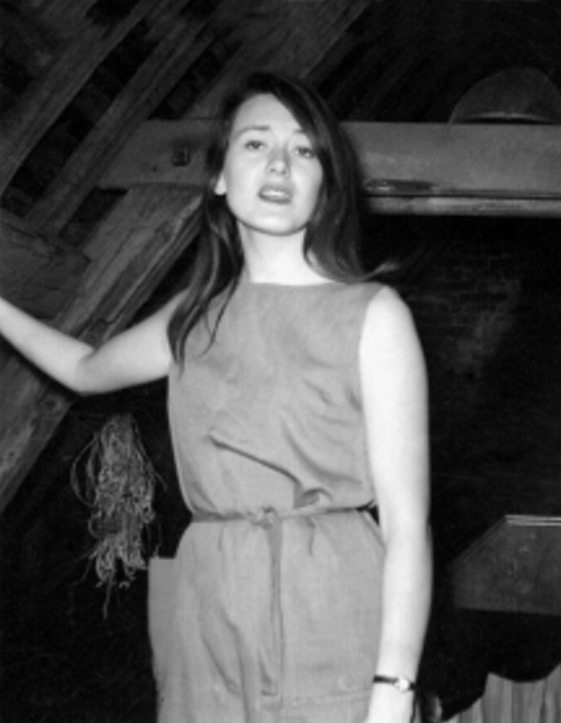
Besides these features of the text and translation, L’événement is an excellent piece of pro-abortion writing through personal anecdote. Unexpectedly, Ernaux dwells not for a moment on the much-discoursed Choice. For many people, of course, abortion is not a matter of agonized morality, but rather of simple necessity. Instead, the narrative traces the excruciating torment of finding and financing a backstreet abortion: prurient colleagues, an apathetic impregnator, medical men with conflicting loyalties, and the touching support of universal sisterhood. She unflinchingly describes the terrifying procedure on a kitchen table, and the later bloody labours on a dormitory toilet. Commentary on the influence of social class is startling in its clarity. Sickening is the present-day knowledge that the legalization of oral birth control in France would finally come only four years after this harrowing experience.
Right, so. Fly. Wall. My moment of dawning awe can only be understood through what I have been reading fairly recently. Last November, I read Nausea by Jean-Paul Sartre (1938, tr.
Baldick 1965), a classic existentialist novel that I found at times wonderfully figurative and at others long-winded. At the beginning of this recent August, I listened to The Second Sex by
Simone de Beauvoir (1949, tr. Borde/Malovany-Chevallier 2009), a brilliant, sybillic, and seminal feminist text. Lastly, also in August, I listened to Irrational Man by William Barrett (1958), a guide to existential philosophy with a robust chapter dedicated to the aforementioned Sartre. No, I can’t be bothered to read Being and Nothingness. It’s 800 pages long. Thus, I take
my perhaps feeble understanding of his thought from Barrett’s summary.
Nausea is a novel about the feeling of horror and disgust (what Sartre calls “nausea”) at the absurd superfluity of the material world. Maybe it will strike you, as it did me, that nausea is a particular and characteristic feature of something Sartre could have never experienced — pregnancy. Elsewhere in his philosophical writing, Sartre also defines two kinds of existence:
in-itself and for-itself.
Being in-itself, or being with no ultimate reason, is the being of Objects, like the trees and flowers. It is absurd, too much, and the root of “nausea.” This concept is threaded with language that smacks of the classical, idealized feminine form: soft, languid corpulence. It is tied ephemerally to the feminine fate of grossesse. An absurd animal fecundity. Grotesque. Ernaux describes the nature of her pregnancy’s sluggish progression with what can translate to a double-entendre in English — “thickening time” (un temps qui s’épaississait).
Sartre’s being for-itself is the masculine to this feminine, the being of Subjects: the human choice, freedom, design, project. The intellectual, the artist. As a student, Ernaux had been used to facility with abstract concepts and theories. Pregnant, nauseous, she felt as though her “intellectual heavens” (ciel des idées) were closing above her.
As you may know, the famed author and existentialist philosopher Simone de Beauvoir was also Sartre’s lifelong lover and partner. For me, this knowledge has made it impossible to absorb either’s writing without hearing the other within it. From my reading, de Beauvoir deconstructs Sartre’s seeming naivety about the accessibility of being for-itself to all humans. The Second Sex nearly exhaustively details Woman in mythology and concept and also in experience. De Beauvoir repeatedly relies on the ideas of immanence and transcendence and of object and subject: perhaps, being in-itself and for-itself. She traces how female humans are “doomed to immanence” by the processes of their body: menstruation, pregnancy, menopause, but also how women are doomed equally by the otherization and objectification of femininity that pervades every thread of our society. Crucially, they (we) are limited again and again every recourse to independence, to choice. To freedom, design, and project.
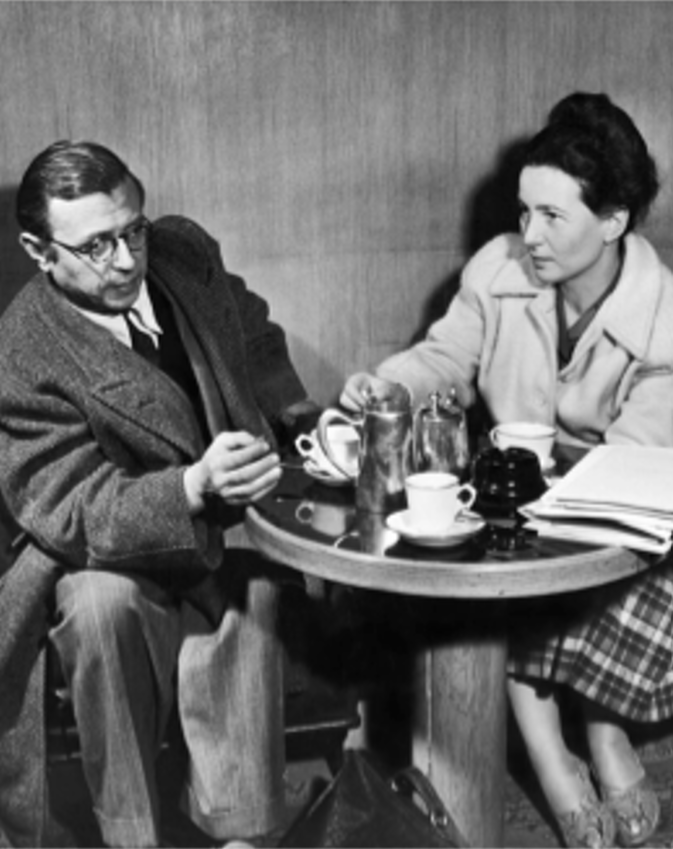
Sartre and de Beauvoir in 1946
Annie Ernaux is French. Highly educated (“well-read,” if you like), she also corresponded with Simone de Beauvoir and has spoken about the influence of the French existentialist duo on her work. She even makes an offhand reference to Sartre’s Being and Nothingness in L’événement. The connections that I sensed subliminally are thus, I can imagine, a deliberate authorial effort to weave her way around and up against their ideas in this memoir.
In a way, Ernaux accepts de Beauvoir’s “doom.” As, against her will, her body proceeded in its natural fertile process, she was increasingly trapped in her immanence and less able to access the freedom of thought that had shaped her former student life. Her peers reduced her down to this pregnant state, including a young student doctor that cursed at her in the belief that she was an uneducated lower-class girl that he didn’t need to have respect for. Inversely, however, her solitary quest for an abortion was the expression of an ultimate freedom, the ultimate project of a subject for-itself. Brilliant, right?
Hopefully that is at least the shadow of what I think is going on here between some of the world’s most respected authors, themselves drawing on a thousand-year wealth of thought and experience of which I have yet to scratch the surface. Maybe you, too, will develop a fascination for 1) feminism 2) existentialism 3) over-intellectualization (evidently) and then read these four books in the same order and be struck by the same thunderclap of Understanding. If so, hit me up. Let’s get married.
More likely, I think, you will read lots of books about things that you love and somewhere in them find a common theme or image or idea that pulses with extraordinary energy. It will leave you, like me (in my book club meeting, embarrassingly), floundering in awe and cursing your own ineloquence. I think that is as good a reason as any to read more, and to read widely.
So, we’re flies. But what more fascinating wall could we have hoped to land on?
September 10, 2026
About The Author
Saachi Deshpande is a third-year Biomedical Sciences student who likes Irish dancing and looking at birds. She’s interested in thinking and reading about feminism, agnostic atheism, and the ways in which people are influenced by their social environment.